
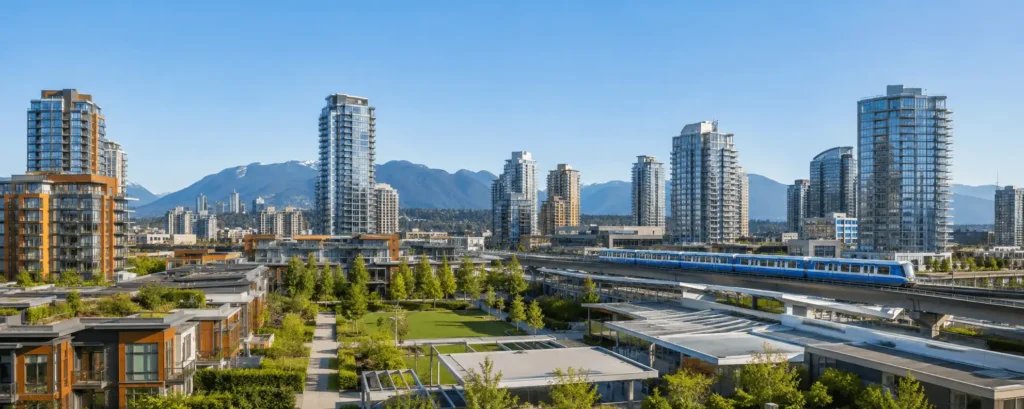

Burnaby can be a strong location for real estate investment, particularly for buyers focused on long-term demand, transit access and population growth. Its position between Vancouver, New Westminster and the Tri-Cities gives residents access to several employment centres, while multiple SkyTrain stations support rental demand in neighborhoods such as Brentwood, Metrotown, Lougheed and Edmonds.
However, Burnaby is not a market where every property automatically produces a good return. Purchase price, mortgage costs, strata condition, rental restrictions, development activity and the type of tenant a property attracts can significantly affect performance.
The Burnaby 2050 Official Community Plan anticipates more than 100,000 additional residents, over 55,000 new homes and more than 50,000 additional jobs by 2050. The city plans to direct much of that growth toward transit-accessible areas while expanding the range of housing available throughout Burnaby.
Our team helps buyers compare properties, neighborhoods and investment risks using current market evidence. Explore Burnaby real estate with Yinon Filler to begin building a personalized investment strategy.
Before You Invest: What Burnaby Buyers Must Understand
A good investment property must do more than increase in value. It should also fit your budget, attract suitable tenants and remain manageable during periods of higher expenses or slower market growth.
Before purchasing, evaluate:
Your investment objective: Decide whether you are prioritizing rental income, long-term appreciation, redevelopment potential or a future personal residence.
Your available capital: Include the down payment, closing costs, repairs and a financial reserve.
Expected rental income: Research realistic rents for comparable properties rather than relying on optimistic estimates.
Monthly operating costs: Account for mortgage payments, strata fees, insurance, property taxes, maintenance and vacancy.
Property condition: Identify repairs that may be required immediately or within the next several years.
Tenant demand: Consider proximity to transit, employment, schools, shopping and Simon Fraser University.
Ownership timeline: Real estate is generally better suited to buyers who can hold through changing market cycles.
💡 Pro Tip: Calculate the investment using conservative rent and expense assumptions. A property that only works when every projection is optimistic may expose you to unnecessary risk.
Why Burnaby Attracts Real Estate Investors
Burnaby offers a combination of location, transportation, housing diversity and planned growth that can support long-term real estate demand.
Central Metro Vancouver Location
Burnaby sits directly east of Vancouver and connects with several major employment and residential markets. Residents can travel toward Downtown Vancouver, New Westminster, Coquitlam and Surrey without leaving the regional transit network.
This location can make Burnaby attractive to renters who work in Vancouver but want additional housing options outside the city’s boundaries.
Extensive SkyTrain Access
The Expo and Millennium lines serve multiple parts of Burnaby, including Metrotown, Patterson, Royal Oak, Edmonds, Brentwood, Holdom, Sperling-Burnaby Lake, Lake City Way, Production Way-University and Lougheed.
Burnaby’s adopted growth strategy places housing and employment growth near frequent transit. The city also intends to support compact communities that combine homes, services, jobs and shopping, strengthening the long-term relevance of transit-oriented neighborhoods.
Population and Employment Growth
The projected addition of more than 100,000 residents and over 50,000 jobs by 2050 may create ongoing demand for both ownership and rental housing. Growth is expected to be concentrated around town centres, urban villages, transit stations and selected corridors.
Population growth does not guarantee that every property will appreciate. It does, however, create a broader demand foundation that investors can consider when evaluating long-term opportunities.
Housing Variety
Burnaby includes:
- High-rise condos
- Low-rise apartments
- Townhouses
- Duplexes and multiplexes
- Detached homes
- Secondary suites
- New construction
- Older redevelopment properties
This variety allows investors to select a property type that matches their capital, management preferences and expected tenant profile.
The Best Burnaby Areas for Real Estate Investment
Different Burnaby neighborhoods offer different investment opportunities. The strongest option depends on whether you prioritize rental convenience, future development, family demand or land value.
Brentwood: Best for Transit-Oriented Condo Investment
Brentwood has experienced substantial residential and commercial development around Brentwood Town Centre Station. New towers, shopping, restaurants and services have transformed the area into one of Burnaby’s major high-density centres.
Brentwood may appeal to investors seeking:
- Modern condos
- SkyTrain access
- Professional and commuter tenants
- Shopping and services nearby
- Long-term transit-oriented growth
Investors should compare new and resale properties carefully. Newer buildings may offer modern amenities but can carry higher purchase prices and strata fees. Future construction can also affect noise, traffic and views.
A smaller, efficiently designed unit near transit may produce stronger tenant interest than a larger condo located farther from services. However, projected rent should always be compared with the complete monthly ownership cost.
Metrotown: Best for Broad Rental Demand
Metrotown is Burnaby’s largest urban centre and one of its most recognizable investment markets. The area provides SkyTrain access, shopping, restaurants, employment and proximity to Central Park.
The neighborhood attracts a wide range of potential tenants, including professionals, families, newcomers and students commuting to other parts of Metro Vancouver.
Metrotown may suit investors looking for:
- A large pool of prospective renters
- Condos in different ages and price ranges
- Strong regional transportation
- Access to everyday services
- Continued high-density development
The exact block and building matter. Units close to major roads or construction may experience more noise, while properties near quieter residential streets may attract tenants seeking a more balanced lifestyle.
Lougheed: Best for Regional Connectivity
Lougheed Town Centre Station connects the Expo and Millennium lines, giving residents access to Burnaby, Vancouver, New Westminster, Coquitlam and Port Moody.
The area includes older condos, newer towers and ongoing redevelopment. This can create opportunities at different entry prices, although investors must investigate planned construction around the property.
Lougheed may appeal to buyers prioritizing:
- Multiple SkyTrain connections
- Access to Simon Fraser University
- New and established condo buildings
- Regional commuter demand
- Long-term redevelopment activity
The planned growth of the surrounding town centre may support future demand, but it can also introduce substantial new housing supply. Investors should evaluate how a specific unit will compete with newer rentals entering the market.
Edmonds: Best for Housing Variety
Edmonds offers condos, townhouses, detached homes and multi-family properties. It can attract tenants who value transit access but prefer a community that feels less concentrated than Brentwood or Metrotown.
The neighborhood includes Edmonds SkyTrain Station, local services and recreation facilities. Properties near transit may appeal to commuters, while townhouses and larger units can attract families.
Edmonds may be suitable for investors seeking:
- A broader range of property types
- Family-oriented rental opportunities
- SkyTrain access
- Potentially different entry points from major town centres
- Proximity to New Westminster and central Burnaby
Investors should assess the immediate area rather than relying only on the Edmonds label. Walking distance to transit and services can vary significantly across the neighborhood.
Burnaby Heights: Best for Established Neighborhood Demand
Burnaby Heights offers a walkable commercial district, residential streets and convenient access to Vancouver. The area contains detached homes, duplexes, low-rise apartments and newer multi-family housing.
It may attract renters who want neighborhood character, local shops and easier access to East Vancouver without living in a high-rise town centre.
Burnaby Heights may work for investors seeking:
- An established community
- Demand from families and professionals
- Access to Hastings Street services
- Lower-density property types
- Potential suite or redevelopment opportunities
Detached properties may involve larger maintenance obligations and higher purchase prices. Any redevelopment or suite potential should be confirmed through current zoning, building and permitting requirements.
Simon Fraser University and UniverCity: Best for Student-Oriented Demand
Properties near Simon Fraser University may offer access to student, faculty and university-related rental demand. Condos and townhouses around UniverCity can appeal to renters who prioritize proximity to the Burnaby campus.
Investors should consider:
- Seasonal tenant turnover
- Unit size and layout
- Transit access beyond the campus
- Strata bylaws
- Competition from similar rental units
- Whether the property also appeals to non-student tenants
A property that serves more than one tenant group may be more resilient than a unit dependent entirely on the academic calendar.
Step-by-Step: How to Evaluate a Burnaby Investment Property
A disciplined review can help investors avoid buying based on excitement, marketing or assumptions about future appreciation.
Define the Investment Strategy: Identify whether the property is intended for long-term rental income, redevelopment or future personal use.
Establish the Complete Budget: Include the down payment, mortgage, closing costs, repairs and financial reserves.
Research Comparable Rents: Study actual local rental competition for similar units.
Calculate Monthly Cash Flow: Subtract all expected expenses from realistic rental income.
Review Recent Sales: Compare the asking price with recent sales in the building and neighborhood.
Inspect the Property: Identify visible defects, deferred maintenance and potential capital expenses.
Review Strata Records: For condos and townhouses, examine financial statements, minutes, insurance and depreciation reports.
Investigate Local Development: Determine whether future towers, roads or community projects could affect the property.
Confirm Rental Requirements: Review applicable strata bylaws, municipal rules and provincial tenancy obligations.
Stress-Test the Investment: Calculate whether you could continue carrying the property during a vacancy, major repair or interest-rate change.
Buyers can review available Burnaby properties to compare current opportunities across neighborhoods and property types.
⚠️ Warning: Do not purchase based only on a developer’s projected rent or appreciation estimate. Verify the assumptions independently using comparable properties and conservative calculations.
How to Calculate Potential Rental Cash Flow
Monthly cash flow is the amount remaining after rental income is reduced by ownership and operating expenses.
A basic calculation may include:
Monthly rental income
Minus:
- Mortgage payment
- Strata fee
- Property taxes
- Insurance
- Property management
- Repairs and maintenance
- Vacancy allowance
- Utilities paid by the owner
The result may be positive or negative cash flow.
A property with negative monthly cash flow is not automatically a poor investment, but the buyer must understand how much additional money will be required and whether the long-term strategy justifies it.
Investors should also plan for irregular costs. A special levy, appliance replacement or extended vacancy can eliminate several months of expected income.
Condo Versus Townhouse Versus Detached Investment
Each property type has different advantages and risks.
| Investment Factor | Condo | Townhouse | Detached Home |
| Entry Price | Often lower | Usually moderate | Often highest |
| Maintenance | Shared through strata | Shared and private duties | Owner responsible |
| Tenant Market | Singles, couples and professionals | Families and long-term renters | Families and larger households |
| Land Component | Limited | Moderate | Usually strongest |
| Monthly Fees | Strata fees required | Strata fees usually required | No strata fee in many cases |
| Redevelopment Potential | Limited to building or site | Depends on complex and zoning | May offer greater flexibility |
| Management Complexity | Often simpler | Moderate | Can be higher |
| Special Levy Risk | Yes | Yes | No strata levy, but full repair responsibility |
Condos may be easier to maintain and offer a lower entry point. Townhouses can attract families and longer-term tenants. Detached homes may offer land value or suite income but usually involve larger financing and maintenance requirements.
The best format depends on your capital, time horizon and willingness to manage repairs.
How Burnaby’s Growth Plans May Affect Investors
Burnaby’s 2050 plan is designed to accommodate more than 55,000 additional homes. Growth will continue around the four town centres and other transit-oriented areas, while provincial rules also require increased density near SkyTrain stations and allow more small-scale multi-unit housing in residential areas.
Transit-oriented areas can permit substantial density, including taller buildings closest to SkyTrain stations. Burnaby is also planning for more townhouses, rowhouses, low-rise apartments and mixed-use neighborhood centres.
For investors, these changes may create:
- More housing supply
- New redevelopment opportunities
- Increased competition among rental units
- Improved neighborhood services
- Construction and view impacts
- Changes in land value
- Greater clarity around long-term growth locations
A growth designation does not guarantee that a specific property will be redeveloped or become more valuable. Ownership structure, lot assembly, zoning, development costs and city approval can all affect the outcome.
✅ Did You Know? Burnaby expects almost all residents to remain within a short walk of a bus stop under its long-term growth scenarios, while higher-density development will remain concentrated near rapid transit and selected corridors.
The 5 Mistakes Burnaby Real Estate Investors Should Avoid
Investment losses often result from incomplete research rather than from the city itself.
Assuming Appreciation Is Guaranteed: Burnaby has long-term growth potential, but property values can decline or remain flat during weaker market periods.
Ignoring Strata Finances: An attractive condo can become expensive when the building has poor reserve funding or major repairs approaching.
Overestimating Rent: Rental projections should be supported by comparable units, not ideal listings that remain vacant.
Buying Only for Redevelopment Potential: Future density does not guarantee that redevelopment will occur on your timeline.
Operating Without a Financial Reserve: Vacancy, maintenance and interest changes can require additional cash.
🏆 Insider Insight: The strongest investment may not have the highest projected appreciation. A well-located property with broad tenant appeal and manageable expenses can provide a more stable ownership experience.
Current Market Conditions and Investment Timing
British Columbia’s real estate market entered 2026 with higher inventory and economic uncertainty. BCREA forecast provincial residential sales to decline by 2.1% in 2026 before increasing by 7.7% in 2027. It also forecast the provincial average price to fall by 1.4% in 2026, partly because of weakness in higher-priced Lower Mainland markets.
For Burnaby investors, softer conditions may provide:
- More listings to compare
- Longer due-diligence periods
- Greater negotiating opportunities
- Less pressure to remove important conditions
However, slower price growth can also reduce short-term appreciation. Investors should be prepared to hold the property and rely on sound fundamentals rather than expecting a rapid resale profit.
Market timing matters less when the buyer purchases a suitable property, maintains adequate reserves and follows a realistic long-term plan.
Online Research Versus Professional Investment Analysis
Public listings and rental websites provide useful starting information, but they do not always reveal the complete financial or physical condition of a property.
| Investment Decision | Professional Analysis | Searching Alone |
| Purchase Value | Recent comparable sales | Asking prices |
| Rental Estimate | Local rental competition | Advertised rents |
| Strata Review | Financial and maintenance concerns identified | Risk of overlooked details |
| Neighborhood Analysis | Transit, development and tenant demand | General descriptions |
| Offer Strategy | Based on market conditions | Price-focused assumptions |
| Long-Term Risk | Property-specific evaluation | Broad market expectations |
Investors can learn more about Yinon Filler and the local approach used to evaluate Burnaby properties.
Through professional real estate services, buyers can compare projected income, recent sales, building condition and neighborhood growth before making a commitment.
Is Burnaby Better for Long-Term or Short-Term Investment?
Burnaby is generally more suitable for long-term investors than buyers seeking a quick resale. Population growth, transit-oriented development and regional connectivity may support demand over time, but transaction costs and short-term market fluctuations can make rapid buying and selling risky.
A long-term investor can potentially benefit from:
- Mortgage principal reduction
- Rental income
- Future appreciation
- Neighborhood improvements
- Greater flexibility around market cycles
The investment still needs to work under realistic assumptions. Long-term ownership does not fix an excessive purchase price, weak building or unsustainable monthly deficit.
Is Burnaby a Good Real Estate Investment in 2026?
Burnaby can be a good place to invest in 2026 for buyers who choose carefully and plan for long-term ownership. The city’s projected population growth, employment expansion, SkyTrain network and continued housing development create important demand drivers.
The strongest opportunities are likely to be properties that combine:
- Convenient transportation
- Broad tenant appeal
- Sound building or property condition
- Sustainable monthly expenses
- Access to employment and services
- A realistic purchase price
- Long-term neighborhood relevance
The correct investment depends on your finances, goals and ability to manage risk. Contact Yinon Filler for a personalized Burnaby investment-property search and market consultation.
Frequently Asked Questions
Is Burnaby real estate a good investment?
Burnaby may be a good long-term investment because of its central Metro Vancouver location, SkyTrain access, population growth and diverse housing market. Performance depends on the purchase price, property condition, rental demand and ownership costs rather than the city name alone.
Which Burnaby neighborhood is best for investment?
Brentwood and Metrotown may appeal to condo investors seeking transit and broad rental demand. Lougheed offers regional connectivity, while Edmonds can provide more housing variety. Burnaby Heights and other lower-density neighborhoods may suit buyers interested in family tenants or land value.
Are Burnaby condos good rental properties?
A Burnaby condo can attract tenants when it offers convenient transit, a functional layout and access to services. Investors must review strata fees, financial records, bylaws, insurance and upcoming repairs before purchasing.
Is Brentwood a good place to invest?
Brentwood offers SkyTrain access, newer condos and extensive commercial development. It may attract professional tenants and commuters, but investors should consider high purchase prices, strata costs, future construction and competition from new rental supply.
Is Metrotown good for rental-property investment?
Metrotown can provide broad rental demand because of transit, shopping, employment and access to Vancouver. Building quality, street location and nearby development should be evaluated individually.
Can I invest near Simon Fraser University?
Properties near Simon Fraser University may attract students, university employees and other tenants. Investors should account for seasonal turnover, competition and the property’s appeal to renters outside the university community.
Will Burnaby property values increase?
No future increase is guaranteed. Burnaby’s projected growth and transit-oriented development may support long-term demand, but property values can fluctuate because of interest rates, inventory, economic conditions and local supply.
What expenses should Burnaby landlords expect?
Common expenses include mortgage payments, property taxes, insurance, strata fees, repairs, property management and vacancy. Investors should also prepare for major maintenance or special levies.
Should I buy a condo or detached investment property?
Condos may offer a lower entry price and simpler maintenance. Detached homes can provide land value, larger rental units or suite potential, but they usually require more capital and direct maintenance. The right option depends on your finances and investment strategy.
How long should I hold a Burnaby investment property?
There is no fixed period, but real estate is generally better suited to a multi-year strategy. A longer holding period can provide more time to manage transaction costs and changing market conditions.